
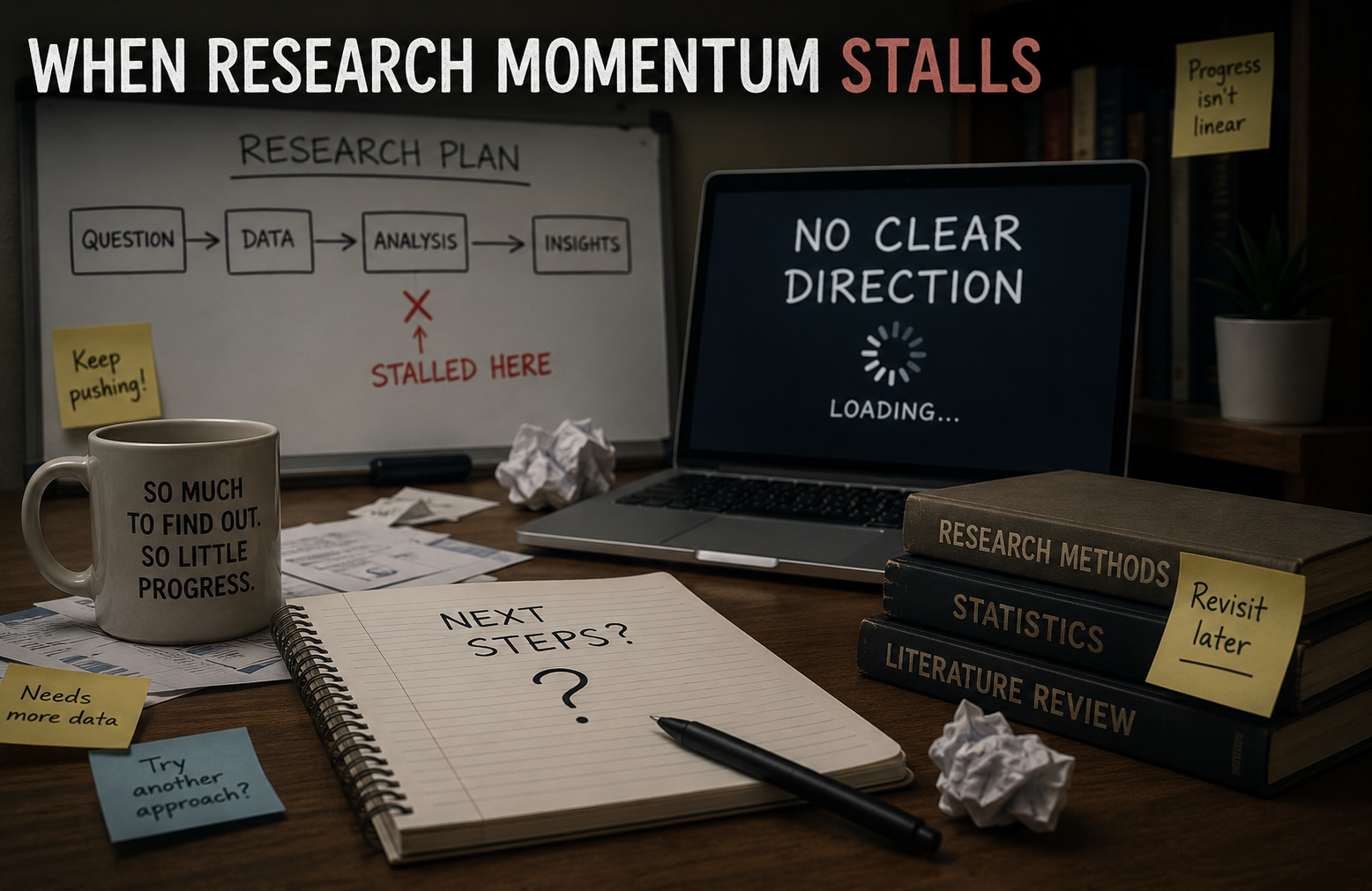
I ran a free webinar a few weeks ago on reclaiming your research momentum, and the number of people who signed up confirmed a hunch I had – that this is something many researchers are dealing with right now. The tertiary sector in particular has been through a lot recently – changes to funding, restructuring, rising expectations with fewer resources (and that’s on top of everything else going on in the world). If you’re feeling exhausted and overwhelmed, that’s a completely reasonable response to your current circumstances.
When momentum stalls, it’s rarely because you’ve stopped caring about your research. It’s usually because your research typically doesn’t have hard deadlines, so it waits while everything else expands to fill the space. And the longer it waits, the harder it becomes to find your way back in. I hear this from researchers often, and the guilt that comes with it just makes it even harder to get started.
In the webinar, I talked about four common things that disrupt momentum and seven strategies for getting moving again. I can’t fit all of that here, but I want to share three ideas that seemed to land particularly well on the day.
The first is one of my favourites, drawn from Jake Knapp and John Zeratsky’s book Make Time. The idea is to choose a daily highlight – one thing each day that you want to prioritise or protect. A highlight can be work-related or personal. Just one thing that, when you look back at the end of the day, you can point to and say – that was my highlight today. What I love about it is where a highlight sits – it’s the bridge between your immediate tasks (which keep things ticking but can become a blur) and your long-term goals (which give you direction but are too big to be useful on a Tuesday morning). A highlight is specific enough to actually do, and meaningful enough to actually matter. The crucial part is that you schedule it – a 60- to 90-minute block in your calendar – and start your day from there, rather than from your inbox.
The second is parking downhill. Before you finish a research session, take two or three minutes to leave yourself a note about exactly where you got to and what you’d do next if you were to continue right now. The hardest part of any research session is almost always the beginning – that gap between sitting down and actually being in the work. If you can make that entry point as obvious and low-effort as possible, you don’t have to spend 20 minutes reconstructing where you were.
The third is the power of quick wins. When you’ve been stuck for a while, your brain starts building a quiet story: I can’t get anything done. Quick wins interrupt that story. Find something small on your research – five or ten minutes, max – and do it. Reread and edit a single paragraph. Clean up five references. Code one small chunk of a transcript. I keep a running list of these for my own work, and on the days when nothing feels possible, I go straight to it.
If any of those ideas feel useful, pick one and try it. Just one – there’s no need to try and overhaul everything at once.
The full webinar recording is on YouTube if you’d like to hear all seven strategies and the discussion we had on the day. We also explore research momentum, habits, and sustainable productivity in depth through the on-demand content library in our Research Accelerator membership, if you’re interested in learning more.
Share this entry
Lyn Lavery
Lyn has taught research methods and data analysis in New Zealand universities for over 25 years. She is an NVivo Platinum Certified Trainer and has previously trained for SPSS NZ, so is confident working across quantitative, qualitative and mixed methods projects. Her own PhD research focused on motivation, time management and information management with postgraduate students, so she’s pretty well placed to help you out with some tips for maximising productivity and reaching your research goals.