
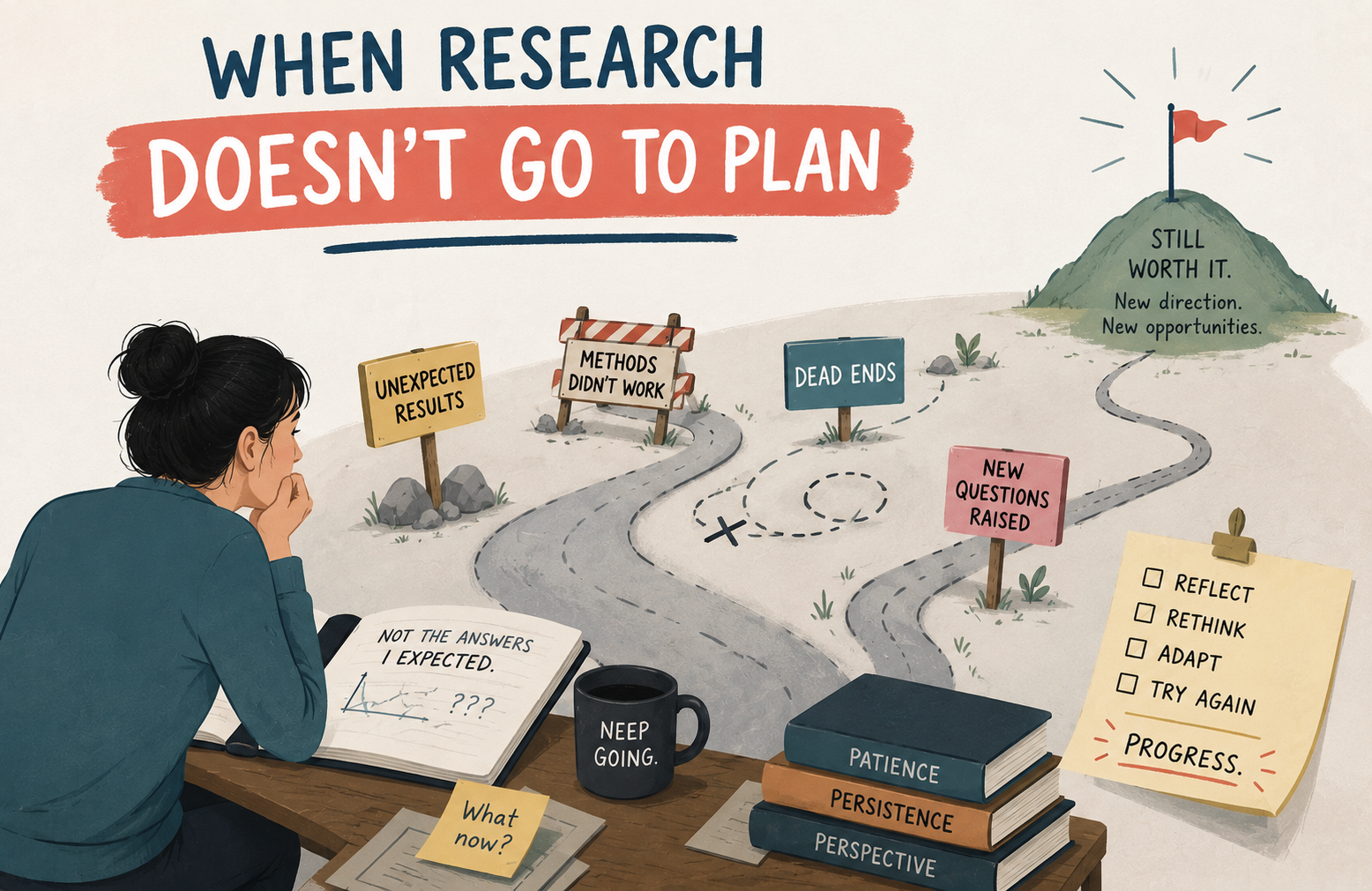
If I asked you whether your research has gone exactly as you planned, I’m fairly confident I know the answer. I asked this question at a recent virtual retreat, and the chat lit up with variations of “No,” “Ha!” and “Definitely not.” Nobody’s research goes exactly to plan. Yet the way we talk to ourselves about our own detours is often as if we’re the only ones whose project has hit a bump.
Research doesn’t really proceed in a straight line. Your methodology might need to change, participants don’t come through, a paper gets scooped, life intervenes, or the data shows something completely different from what you hypothesised. These things happen to everyone at every stage and in every discipline. But in the moment, a detour can feel a lot like failure – and that’s worth unpacking a bit.
I think four feelings make research detours particularly hard. The first is loss of control – you had a plan, you were attached to it, and now something’s making it impossible. The second is fear of wasted time – all that reading, all that data collection, has it been for nothing? The third is comparison – particularly painful in academia, where everyone else’s timelines are public, and you might be on a detour while they look like they’re going straight ahead. And the fourth is uncertainty – detours don’t come with a map, and that absence of certainty can feel paralysing.
All four of those are real and all four are normal. But the framing I keep coming back to is this: a detour isn’t a failure – it’s data. As researchers, we know what to do with data – we get curious about it and we ask what it’s telling us. We don’t beat ourselves up because the data didn’t confirm our hypothesis – we listen to what the data actually says. A detour in your research life works the same way. The question isn’t “Why is this happening to me?” — it’s “What is this telling me?”.
Think about penicillin, Post-it Notes, and the microwave oven. Every one of those started out as something entirely different. The researcher wasn’t trying to invent that thing – they were trying to solve a different problem. What made the difference was that they paid attention to the anomaly instead of dismissing it. They didn’t say “Well, that’s a failed experiment.” They said “That’s odd – what’s going on there?”
That shift from criticism to curiosity doesn’t make a detour easier or shorter. But it does change your relationship with it. There is nothing wrong with finding detours hard. You can be a capable, committed researcher and still feel rattled when your project takes an unexpected turn. A rough patch doesn’t mean you chose the wrong topic or the wrong career. It means you’re doing something that’s genuinely difficult, and your feelings about that are valid.
We explored research detours and a practical reframing activity during our recent Research Accelerator retreat. The session (along with the full retreat content) is now available in the on-demand content library for members.
Share this entry
Lyn Lavery
Lyn has taught research methods and data analysis in New Zealand universities for over 25 years. She is an NVivo Platinum Certified Trainer and has previously trained for SPSS NZ, so is confident working across quantitative, qualitative and mixed methods projects. Her own PhD research focused on motivation, time management and information management with postgraduate students, so she’s pretty well placed to help you out with some tips for maximising productivity and reaching your research goals.